
Overview
Manifold Standard Overview
Info
For now, this website serves as both the documentation for Exterior Space and the standard manifold.
We will later separate the documentation for manifold and make it standardized.
Exterior Space is the reference implementation of manifold,
the standard for virtual spaces,
so understanding it is understanding the standard itself.
Although similar implementations exist in products and games,
they remain closed platforms that fragment users’ memories, creations, and belongings,
while a standard provides the common ground for
decentralized, user-owned worlds open to anyone, anytime, anywhere, with any digital assets.
manifold is a deliberately simple standard.
The essence of the manifold standard lies not in technical complexity
but in how to design a framework that enables a person, or any being, to experience a virtual space.
Therefore, throughout the document, we use Exterior Space’s implementation as examples
to help readers understand how users can build and interact with spaces based on the standard in practice.
In this overview, we briefly introduce all systems and important modules of manifold version 0.0.1.
In general, the standard defines a virtual space where users can
store, arrange, decorate, present, generate, update, and interact with digital assets.
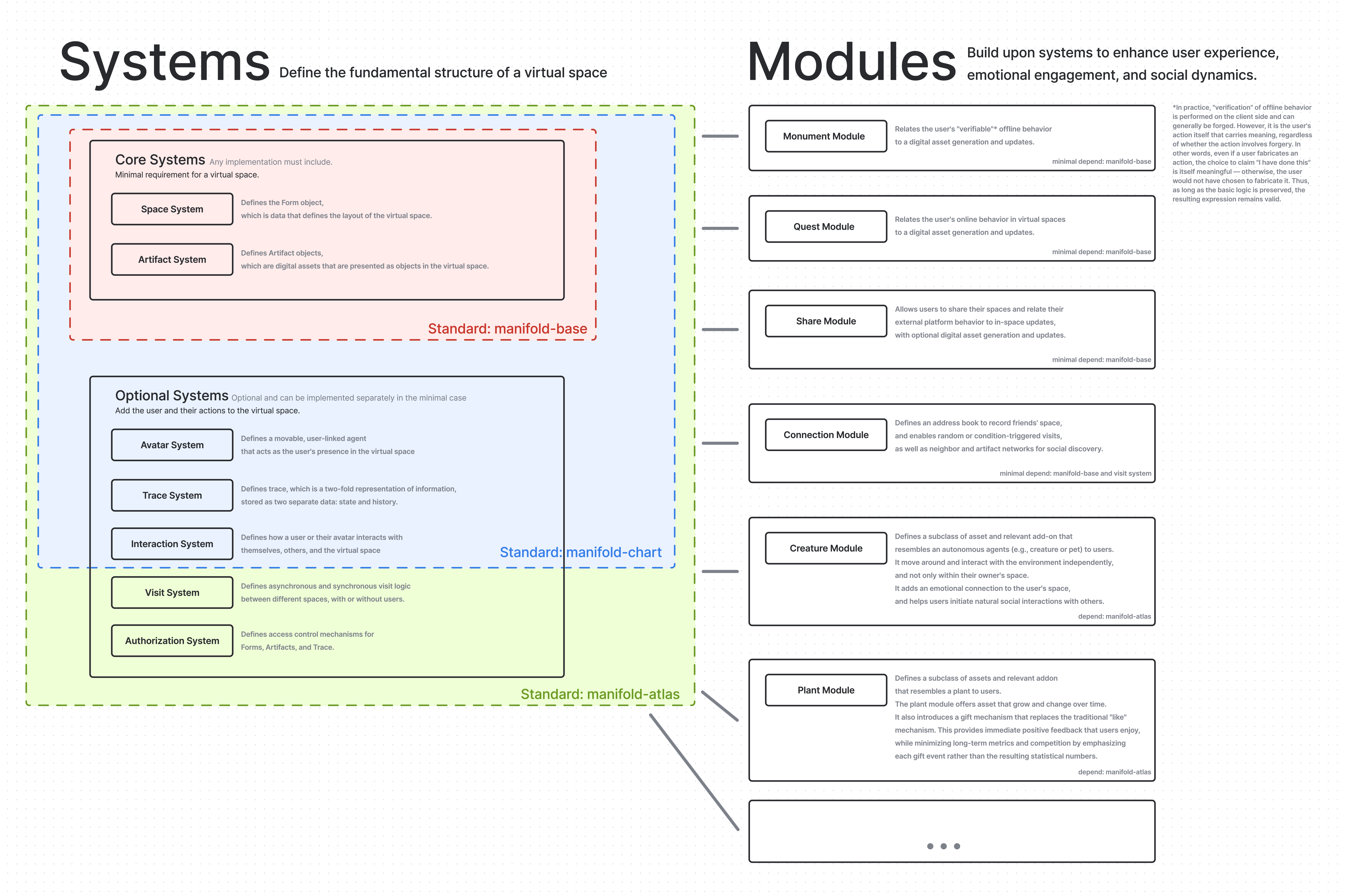
The standard is organized into systems and modules:
two core systems define the basics of a virtual space,
the other systems extend how users can ‘live’ within it,
and modules build on them to enhance experience and engagement.
Systems
Core systems
Core systems are the minimal requirement for a virtual space, this forms the standard manifold-base.
Any implementation of manifold must include all core systems.
Space System
The space system defines the Form or ExtForm object,
which is data that defines the layout of the virtual space.
Form must comply with certain rules defined by the layout mode.
There are so far three Form layout mode, at least one must be implemented:
- The freeform layout mode: any layout is allowed.
- The discrete layout mode: artifacts in the layout must follow a grid logic and comply with the stack logic.
- The continuous layout mode: artifacts in the layout must comply with the stack logic.
Artifact System
The artifact system defines Artifacts, which are digital assets that are presented as objects in the virtual space.
They must implement certain interfaces defined in the standard.
Static Artifacts are commonly referred to as furniture.
We want to remind developers and artists that
digital assets do not necessarily take a defined form —
they can be any data: an object, a history record, a concept of ownership, and more.
Optional Systems
Optional systems essentially add the user and their actions to the virtual space. It makes the space meaningful and creates a connection to the user.
Optional systems are optional and can be implemented separately, but within each system there are features that can only be implemented if one or more other systems are also implemented.
It is recommended to implement the avatar, trace, and interaction systems together.
Combined with the core system, they define the manifold-chart standard.
It is also recommended to implement the visit and authorization systems together.
When the core system and all optional systems are implemented, they define the manifold-atlas standard.
Avatar System
Avatar System defines the avatar object,
a movable, user-linked agent that acts as the user's presence in the virtual space.
Avatars may be used to initiate spatial interactions or act as interaction targets.
Trace System
Trace System defines trace,
which is a two-fold representation of information, stored as two separate data:
state: A required data, recording the current state of the virtual space (user preference is also considered part of the state).history: An optional data, recording all the relevant events that happened in the virtual space.
Ideally, if both data types are implemented,
state may be verifiable using history, and history may be able to reconstruct state.
Interaction System
The Interaction System defines how a user or their avatar interacts with the virtual space. It supports two forms of interaction:
- Interface interaction: interaction between non-avatar-centered user interface events and the virtual space.
- Behavior interaction: interaction between an avatar and other objects or avatars within the virtual space. Each type of interaction can be implemented independently.
It can be considered as an addon to the artifact system and avatar system.
Visit System
Visit System defines asynchronous and synchronous visit logic between different spaces, with or without users.
Authorization System
Authorization System defines access control mechanisms for Forms and Artifacts.
Modules
While systems define the fundamental structure of a virtual space, modules build upon these systems to enhance user experience, emotional engagement, and social dynamics. Modules are optional; they provide additional layers of interaction, personalization, and growth, without altering the underlying structure of the space itself.
Each module is optional and can be implemented independently, although some modules are designed to work better when combined with certain systems or with each other.
Monument Module
The idea of the monument is to allow people to bring their existence from the physical world online. Most importantly, it offers a way to digitally capture a user's lived experience — a living memory. In other words, its purpose is not merely to replicate a digital twin, but to realize a conceptual embodiment — a digital form shaped by the user's own experiences and choices.
Monument module relates the user's "verifiable" offline behavior to a digital asset generation and updates.
In the minimal case, this module only depends on the core system.
In practice, "verification" is performed on the client side and can generally be forged. However, it is the user's action itself that carries meaning, regardless of whether the action involves forgery. In other words, even if a user fabricates an action, the choice to claim "I have done this" is itself meaningful — otherwise, the user would not have chosen to fabricate it. Thus, as long as the basic logic is preserved, the resulting expression remains valid.
Quest Module
The idea of the quest module is similar to that of the monument. Its advantage is that, in the online world, verification can be reliably enforced. Thus, the form of a quest can be more versatile — ranging from traditional puzzle-solving quests in games to online wedding events. It serves as the living memory of a digital life.
Quest module relates the user's online behavior in virtual spaces to a digital asset generation and updates.
In the minimal case, this module only depends on the core system.
Share Module
We all want to show our new home to friends, and we all want to share novel souvenirs after a trip. The share module allows users to share their spaces and digital assets with friends or on social media, and to collect their feedback back into the space.
Share module allows users to share their spaces and relate their external platform behavior to in-space trace updates,
with optional digital asset generation and updates.
In the minimal case, this module only depends on the core systems.
Connection Module
The connection module offers users the ability to easily access other spaces, either friends' spaces or those of strangers. Besides the obvious usage of visiting friends, visiting strangers' space provides a softer, lower-pressure scenario that reduces the mental barrier for users to start new friendships and explore new worlds — especially with condition-triggered visits, as they create naturally initiated social interactions and a shared topic to start.
The connection module defines an address book for each user to record friends' space addresses
and enables random or condition-triggered visits.
Condition-triggered visits are initiated by two paired related Artifacts.
This module also creates a geographic space network, a virtual space network, and an artifact network.
In the minimal case, this module depends on the core systems and the visiting system. It is recommended to implement condition-triggered visits in combination with the monument and quest modules.
Creature Module
Humans naturally form strong emotional connections with different creatures. This connection arises because they grow, remember, and change over time. Creatures can even guide users to visit different spaces together, creating new experiences and shared memories. Their presence turns a static space into a flowing, evolving environment.
Creature module defines a subclass of Artifact and relevant trace addon that resembles a autonomous agents (e.g., creature or pet) to users.
The creature module offers Artifacts that move around and interact with the environment independently, and not only within their owner's space.
It adds an emotional connection to the user's space, and helps users initiate natural social interactions with others.
This module depends on all systems.
Plant Module
The plant module brings life, growth, and the quiet passing of time into virtual spaces, letting users feel the seasons change, and their spaces slowly grow and transform. Plants naturally produce small gifts — a green leaf, a flower petal, a dandelion puff — that fall over time. These small gifts can be offered to others, left behind in their spaces, or attached to their memories as gentle signs of appreciation. Through plants, small acts of appreciation become organic parts of the virtual world's memory.
Plant module defines a subclass of Artifact and relevant trace addon that resembles a plant to users.
The plant module offers Artifacts that grow and change over time.
It also introduces a gift mechanism that replaces the traditional "like" mechanism.
This provides immediate positive feedback that users enjoy, while minimizing long-term metrics and competition
by emphasizing each gift event rather than the resulting statistical numbers.
This module depends on all systems.